Showing posts with label Posts. Show all posts

Wednesday, 21 March 2018

The End of My Assignment: Augustinian Lessons in Failure

I.

My assignment at Dandelion has been terminated.  The reason is medical, based on the relatively short amount of time remaining and my counselor's opinion that an immediate return is not ideal.

I disagree with the decision.  Even at the height of my episode at the end of January, I disagreed with the decision to send me home.  I felt I could have continued to perform my duties at Dandelion without going home.

I don't repent of that opinion either.  I know myself.  Tree planting is a tough job, but I know I will be one of the toughest on the crew.  I won't quit before the season's done, and I'll start to heat up at the end when most people are struggling to finish.

So what?  What am I trying to prove?

II.

In his work on St. Augustine, former Archbishop of Canterbury Rowans Williams distinguishes between two views of how suffering builds character.

Williams describes the first as the "moralistic" view. On this view, suffering is seen as an opportunity to do the right thing.  Maybe it hurts you to do right by someone, but you do it anyway.  The suffering continues because your action is not designed to get you out of your own suffering but to do right by the other person.  In this way, suffering also teaches you endurance.  By going through suffering, you thus become a "moral athlete."

This is the type of "character building" that happens during tree planting.  You learn perseverance, but, it must be said, in the service of a shallow view of "doing the right thing."  You kill yourself out of a loyalty to your foreman and crew, and the commitment you made at the beginning of the season.

I think that having a shallow view of "doing the right thing" is often a weakness of this view of suffering, more generally.  How do you know you are "doing the right thing"?

Friedrich Nietzsche, someone with a profound understanding of human psychology and morality, knew this as well.  In Ecce Homo, he writes:  "My experiences entitle me to be quite generally suspicious of the so-called 'selfless' drives, of all 'neighbor love' that is ready to give advice and go into action" (228).

Who knows what could be lurking beneath my "moralistic" drives?  Maybe I wanted people to eventually notice how enduring and selfless I was, and get rewarded.  Maybe focusing on others was my way of indulging in a "will to death," or "will to failure," as my own dreams crumbled.  Maybe I wanted to prove that a Christian view of love will win out because I did not trust God to prove that without me.  Maybe this is the original sin: to think of yourself more highly than God.

A professor of mine once described consciousness as a spider monkey sitting on the shoulders of a gorilla, trying frantically to get the gorilla to look in the right direction.  So just because we think we are being selfless or loving our neighbor, doesn't mean that that is what we are really up to.  Our conscious efforts are seated on a much deeper, more persistent aspect of our personality.

Augustine also recognizes this about us.  As Rowan Williams writes:

"Augustine's undiminished appeal to a post-Freudian generation has much to do with this aspect of his thought.  He confronts and accepts the unpalatable truth that rationality is not the most important factor in human experience, that the human subject is a point in a vast structure of forces whose operation is entirely obscure to reason" (73).

This is a serious limit to viewing suffering as an opportunity for "moral athleticism."

III.

However, as Williams points out, Augustine's view of suffering is more profound than this.

Augustine sees suffering as having more to do with a revelation of God's grace than an opportunity for our own works.  Through our suffering, we learn the hard truth that all the good things around us are not God but his gifts, and that, therefore, they are finite things which pass away and cannot fulfill our longings for meaning and intimacy.  This is a revelation that, if internalized, might help us to get us through our grandiose delusions concerning the moral worth of our "athleticism."

But how are we to internalize it?  Am I the only one who has trouble desiring God more than human intimacy and meaningful work?  As I am, it is difficult to see myself "at rest" without these things.

During my episode, at least this much of my own heart was revealed: I do not want to be drawn into the Trinitarian life of God alone; I would rather get lost along the way to God and rest in the shade of the divine light.  There I could enjoy an eternal intimacy with the people I love, with all the hurt and misunderstanding overcome.  There I could laugh and cry and enjoy the presence of those people (perhaps especially a young lady) who God made me to be especially compatible with in the depths of my being.

The abrupt end of the meaningful work and intimate friendships I was just experiencing on my assignment is perhaps an opportunity to learn some theological realism.  We don't get what we desire because we do not yet desire according to the truth of things.  The following passage in Williams' study expresses a truth that hits close to home:

"The Confessions return often to the theme of friendship and its intense importance in Augustine's life; yet here -- almost as an aside -- is the mature man's judgment on the tantalizing inadequacy of human intimacy.  The heart cannot rest even in the heart of another; and this is not the smallest of incomprehensible griefs of human life" (77).


IV.

I am beginning to see that my situation is no longer an opportunity for 'moral athleticism.'  The original, measurable goals of my assignment were not completed.  And so it is clear that my own finitude has resulted in failure.

Finitude, failure and the suffering that comes with it, is not sin.  On the contrary, Augustine points out that Christ too suffered in the finitude of humanity.  Christ suffered weakness, rejection, betrayal and psychological anguish.  Augustine infers that, if Christ went through this, then going through it cannot be considered sin.  There is no reason to feel guilt because of a bad result.

Pushing further into Christ's suffering, Augustine sees how it, even more than our own suffering, reveals the character of the world: "a world that crucifies its God, crucifies compassion, that crucifies beauty" (80).  The point is driven home.  If "doing the right thing" is modelled on Christ's interactions with the world, then there is no choice but to come to terms with suffering, with failure, with the finitude of the things of the world.

We are forced to keep our eyes on God.  When we do this, we see that he is with us in our suffering.  This is the story of the cross, and Christ's work after the victory of his resurrection as well.  On the Damascus road, Jesus identifies with the suffering church: "Why do you persecute me?"  In the last days, he will identify with the suffering poor of the world: "I was hungry and you gave me something to eat" (v. 35).

V.

Am I ready to accept the lesson that my heart is restless until it rests in God?

Even now, as I accept the limits of my moral athleticism, I do not want to learn Augustine's lesson.  Even now, I am not fully convinced of it.  It is hard for me to see how I could be happy apart from God's gifts.

The opportunity now is to accept God's grace, despite the finitude of his gifts, despite the failure of my work.  If there is any story that will break my hard heart toward God, it is the story of God identifying with us in our suffering at cross.


Monday, 5 March 2018

My Mental Breakdown in Cambodia

Dear Reader,


I have not written here in awhile, and there is a good reason for that!  


I had a severe mental breakdown in late January, and, as a result, I lost faith in my ability to communicate appropriately.  The most destructive part of my breakdown was in what I said to others while it was happening, and it is only gradually that I have felt a normal ability to be discriminating about my speech return to me.

I want to give those who don't know what happened to me a clearer picture, and to express feelings of gratitude to those who rescued me.


I will not go into details or name any characters in this story, other than giving some people who were there for me in my worst moments the thanks they deserve.


Here is my story.


I.


I left for a two week vacation to Cambodia in mid-late January.  


By that time, a critical mass of stress had built within me.  At a conscious level, I acknowledged that my circumstances were out of my control and so had to be placed in God's hands.  I had been wounded in an area of my life where I had only recently learned to renew my faith in God.  I had thought that God was answering my prayers in this area, but this had all come crashing down on me.


I was praying and practicing good daily habits.  I was pursuing what was good to the very best of my ability.  However, there was an underlying conflict between my circumstances and my beliefs about God.  I would put it this way.   As of yet, I did not have the courage to acknowledge that my renewed faith was not in God himself, but in an idea of God that had just been proved false by my circumstances.  So, deep down, what I was trying to do was to wrestle down my dragons on behalf of this dying idea of God that I was holding onto. 


This is what I brought with me to Cambodia.


II.


Before I arrived, my mind had already begun to race out of control.  Soon my mood also began swinging between the basement and the heavens.  This oscillation appeared to correspond to my thoughts, as well as physical symptoms I was experiencing.  Then I began seeing things that weren't there.  Eventually, my view of reality totally disintegrated, so that I had no idea what in my experience was a part of the objective world and what was in my head.


This continued for a week and a half.


During this time, I experienced at least one undeniable miracle, which is that I found a practical application to studying Metaphysics.  I think this training allowed me to hold my perceptions and interpretations of reality at arms length, and to continually test my delusions as I encountered new experiences and interacted with people around me.


For about a week, I had primarily theological interpretations of my experience.  For example (and yes, there were more), I thought God was revealing himself in an extraordinary way, or that I had passed through God's judgment and begun to enter a heavenly state.  As these drastic delusions were eroded, I continually distinguished between my particular theological interpretations of reality and the idea that somehow God was at work.


If I did not make this distinction, I think I would have lost my faith.  Either that, or remained in a state of deep delusion.


III.


After about a week, people at MCC in South Korea and Cambodia realized that something had gone terribly wrong with me.  Despite my protests, the decision was made to send me home.  I was safely accompanied back to Canada.  


This happened at the end of January.


There are several people who deserve all the gratitude I can give in return for the help they gave me.  They are all significant reasons why I am doing as well as I am now.  These are Donna and Chris, my MCC representative in South Korea, Jacob and Annalisa, from MCC's office in Cambodia, Solmin, a friend from Korea, and especially Sovannara, a friend from Cambodia who used his training volunteering at Menno Home in Abbotsford to look after me during my breakdown.


Since I returned home, I have been looked after by Sophie, Wade, and Robyn from MCC.  I have also received encouragement from my friends Dante and Mina at Dandelion, as well as Dr. Insoo Kim, Dandelion's founder and leader, who, as he has just reminded me, continues to pray for me without forgetting, and looks forward to my return.


Finally, I would like to express my regret and embarrassment at how I spoke to many people during my breakdown.  I have thought about how uncomfortable and disturbing a lot of this speech was to many of you.  The tone of superiority with which such ridiculous or horrible things were said only made things worse.  I have no idea how to move past interactions like that.  Please know I regret my words and that I apologize for the damage that they did.


IV.


I am writing this from my home in Canada.  I have been wrestling with all the emotions that go along with an experience like this.  I have received encouragement and support from MCC, my church, my friends, my family, and my community back in South Korea.


Please pray for me, as a decision about whether I am fit enough to return to the Dandelion community will be made very soon.


Sincerely,


Robert


---


Where is this peace to be found? The answer is clear. In weakness. First of all, in our own weakness, in those places of our hearts where we feel most broken, most insecure, most in agony, most afraid. Why there? Because there, our familiar ways of controlling our world are being stripped away; there we are called to let go from doing much, thinking much, and relying on our self-sufficiency. Right there where we are weakest, the peace which is not of this world is hidden.


In Adam's name I say to you, "Claim that peace that remains unknown to so many and make it your own. Because with that peace in your heart you will have new eyes to see and new ears to hear and gradually recognize that same peace in places you would have least expected.


Henri J.M. Nouwen


Sunday, 10 December 2017

My Work Three Months Later: Beauty and Growing Pains

It has now been three and a half months since I arrived here at the Dandelion Community, and three months since my first reflection on my work.  So much has happened; it feels like a lot longer!  

Here is a bit of what I have been up to, and some reflection on it.

Teaching English


Since finishing Korean classes at the end of October, I've been teaching conversational English twice a week.  Every class, I organize the lesson around a "speech act," that is, something you do with language, like promise or warn or congratulate.  I've been teaching students expressions used in everyday English to perform or describe each speech act.  I have a short lecture, followed by activities and games.  I have a lot to learn about teaching English, but I think I hit upon a good way to organize a class about conversational English, and the students seem to enjoy it.

Preparing Fields

Dr. Kim has come up with plans for how to use Dandelion's land.  There will be two large fields devoted to farming potatoes and soy beans which will be sold to Dandelion's customers.  There will be one field full of garden boxes that students will manage individually to learn about farming and to grow their own food.  Finally, Dr. Kim wants to make the field we use to grow food for the community "the most beautiful garden in Korea," by arranging flowers among the crops.  The beauty is supposed to attract people to the community, as well as creating a space for them to rest, reflect and, ultimately, become a part of Dandelion's larger mission of simple living and helping the rural poor.

I've taken on the job of clearing the fields of weeds in preparation for all this.  It is something I know how to do and which I can do to fill my day in-between other work.  It is inspiring to me to have my work be directed toward this end and become a part of the beauty of this place.

Peculiar Beauty

Sometimes I feel like I am living in a painting.  The Dandelion Community is at the bottom of a narrow valley surrounded by high serried hills.   Fields and persimmon orchards cover the valley and parts of the hills, which also have many wooded areas.  There is a village nearby with small, traditional Korean houses. 

It is now late Autumn, and the blanket of greenery that covered everything in Summer has given way to a duskier, more variegated scene. The luscious plant-life on the valley floor, which grew even over buildings, has died or been harvested, turning everything different shades of yellow and brown.  The green arrowroot that smothered the hills has dried up, revealing the more restrained palette of pine, bamboo and by-now-bare deciduous trees.  Nearby persimmon trees dangle their bright fruits against the pale blue sky, as magpies flit quickly through the cold air in anfractuous, arcing lines.  At night, the the dark forms of houses frame the stars, and the moon is visible through the crooked branches of trees.


The beauty is so particular, so boldly peculiar: the abundance of the vegetation, the angles of interlocking branches, the movement of the stars and moon.  It's like a great painting or piece of music.  Great artwork also has this beauty-through-bold-particularity, like, for example, Bach's melodic lines.  Only later, through familiarity, does the beauty come to seem less peculiar and more iconic.

Sustaining and Transcendent Beauty

In some ways, though, this place does not feel like a painting.  For example, I could not spend a lifetime in a painting without growing tired of it, yet I do not think I would ever grow tired of the beauty of this place.  I can appreciate great art again and again, over many years.  Yet not even the greatest of human art can I appreciate continuously without taking a break from it.  But the beauty of this place is such that I would not grow tired of it. 

I have thought the same about the forests of British Columbia.

This is beauty that transcends and so sustains life.  It remains constant irrespective of what is going on with me: my successes and failures, my hopes and anxieties.  Beholding it, therefore, is a way to transcend myself and, in Wendell Berry's phrase, "rest in the grace of the world."

Some Growing Pains Being In Community


For this reason, beauty, along with friendship, is a part of my experience for which I am especially thankful.  This is all the more true because of some of the anxieties I've had as I learn better how to work in community.

One of my anxieties has come from realizing I am not wholly well-adapted to a simple, community lifestyle.  It has certainly been useful for me to know how to do labour work well.  However, living here has made me realize that who I am and what I have learned has been shaped by my privileged life in modern Canadian society.  I sometimes feel a little useless.  In particular, skills bound up with the use of the English language and manipulation of concepts, which I have developed in my life, do not appear to be very much use in making a concrete contribution to the community.  I feel lacking in practical know-how having to do with cooking, growing food, and the complexity of relationships that make up community life.  

I am improving slowly, and coming to realize that having weaknesses is OK.  Living in community  means trusting others for basic things like food, health and good relationships.  So, being in community also means being vulnerable to how well others are doing in their own walks.  As far as food and health, there is no danger of not being taken care of here.  Yet there is indeed a spiritual battle to be fought to maintain trust in others to treat you well and to not consider your weaknesses a burden.  If you do not maintain this trust, or others break it, it is all too easy to be tempted with the usual list of vices: jealousy, pride and resentment being near the top of the list.

Some Growing Pains Working In Community


Another anxiety comes from having a schedule that is largely self-regulated.  I get occasional direction and feedback, but, within the framework of regular duties, I often decide how to spend my time.  I set rules for myself and try to keep busy.  I do this partly from love of the work and partly because I would make myself miserable if I were not busy.

I think I have done fairly well at this, but sometimes I am uncertain.  To be honest, it has been disorientating to not have a regular work day followed by personal time.  Some of my anxieties are about whether I am working enough, whether I am around the community enough, how well I am doing my work, whether others consider all the work I am doing as a valuable contribution to the community.  

I also worry that seeing my work through the lens of my previous jobs may be leading me to disproportionately emphasize things like showing up on time and working hard over against things like participating in community activities where I do not contribute anything in particular, like when students go on special trips.  I have tended to choose to stay home during these outings in order to do other work or to rest.

Having this lens also creates a greater risk of under-appreciating, and, God forbid, even resenting fellow workers when they do not live up to the standards I have set for my own work.  This circumstance has meant working on questioning my own presuppositions about work, and, in addition, trying on some humility and the wisdom to know that God gives his children different gifts and different ways to serve him.

Being and Doing

Many SALT assignment descriptions warn potential SALTers that their assignment may turn out to be more about "being" than "doing."  That is, to live well with yourself, with God, and with those around you may be a more important part of your work than accomplishing projects whose good effects are immediately visible and measurable. Such warning is thought to be necessary because the West tends to over-emphasize the value of "getting things done" and under-emphasize "being with others."

Let me use the framework of being vs. doing to conclude this reflection on my work.  In the end, I think both my anxieties -- about being a good community member and doing good work -- are founded in real concerns.

On the one hand, I do need to learn better habits of "being," and some of my ideas about the value of "getting things done" need to be questioned.  Things under the heading of being -- the beauty of the world, friendship, living justly with the poor, and peacefully with enemies -- are indeed what my time here, and life in general, is all about.  Sometimes I am forgetful of this as I busily do things for my own reasons, or when I worry in a selfish way about my own lack of ability.

On the other hand, I know that work directed at a good end and performed with competence is a part of human flourishing, and that being lazy is not an option.  I want to work as hard and as well as if I were earning a wage.  As far as I'm concerned, if I did not do this, it would be a refutation of what this year is supposed to be about.  I am not here to complete an exercise in useless idealism.  I am here to try to figure out how, in a community like Dandelion, good work, done in the cause of things like beauty, love and justice, can be a reality.

Saturday, 4 November 2017

In the City, On the Mountain, Among the Community - Pictures and Stories from October

Working

Feeding chickens and collecting eggs in the morning.

Sorting and packing eggs to be sent to customers.  I've been told egg production has really picked up!  Jonghyeon is behind me and Solpa is to my left.  They both recently graduated from school and work on the farm occasionally.  Jinha in the back is in charge of the farm.

Planting garlic with students in the farm class, which is lead by my housemate and former SALTer, Wilhelmina Witt (Mina).

Just doing a little weeding around the greenhouse.  As a treeplanter I was known as "the Pounderine," and then as the "Honey Badger."  Here they call me "Hedgehog."

Last week, Jinha harvested rice.  We dried it along the road for a few days (you see this being done a lot in these parts this time of year).  In this picture, I am collecting the dried rice with Hagyeong, a high school student.

Learning Korean

Dante and I attended Korean language classes for one month at the YWCA in the city of Jinju.  In this picture, we are celebrating Chusok (a bit like Thanksgiving) as a school.  Many women from around Asia dressed up in their traditional clothes.  Dante did also.

This is my greatest work in the Korean language to date.  It is called "My family..."  I think I really nailed the last line.

"My family consists of my dad, my mother, and three younger brothers and, making us six people.  We are all Canadians, but I now live in Korea.  My younger brothers' names are Michael, David and Aaron.  Michael is a computer programmer; David and Aaron work with my dad.  These brothers are RV technicians....

I am twenty-seven years old.  There is two years difference between Michael and I, two years difference between David and Michael, and three years difference between Aaron and David.  I will go to Canada, and so see my brothers next Summer.  Because we have the same parents, we resemble each other."

Teaching at Dandelion

Korean classes are now over, and so Dante and I now have time to teach English and be more involved in the school.  This is a picture taken from a game I organized for recreation time.  It's called "Celebrity Selfie Hunt."  Students split into teams and take selfies with teachers, who hide around the community.  The team who takes selfies with all the teachers without getting caught by the security guard first wins.


Mina is holding the chicken.  Geonweon, on the left, led one student team, which also included Seongeun, between Geonweon and Mina, Hagyeong, hiding behind Mina, Jihong, behind Hagyeong, and Serin, on the far right.

Here they found Seoyeong, the Korean teacher.

At our house

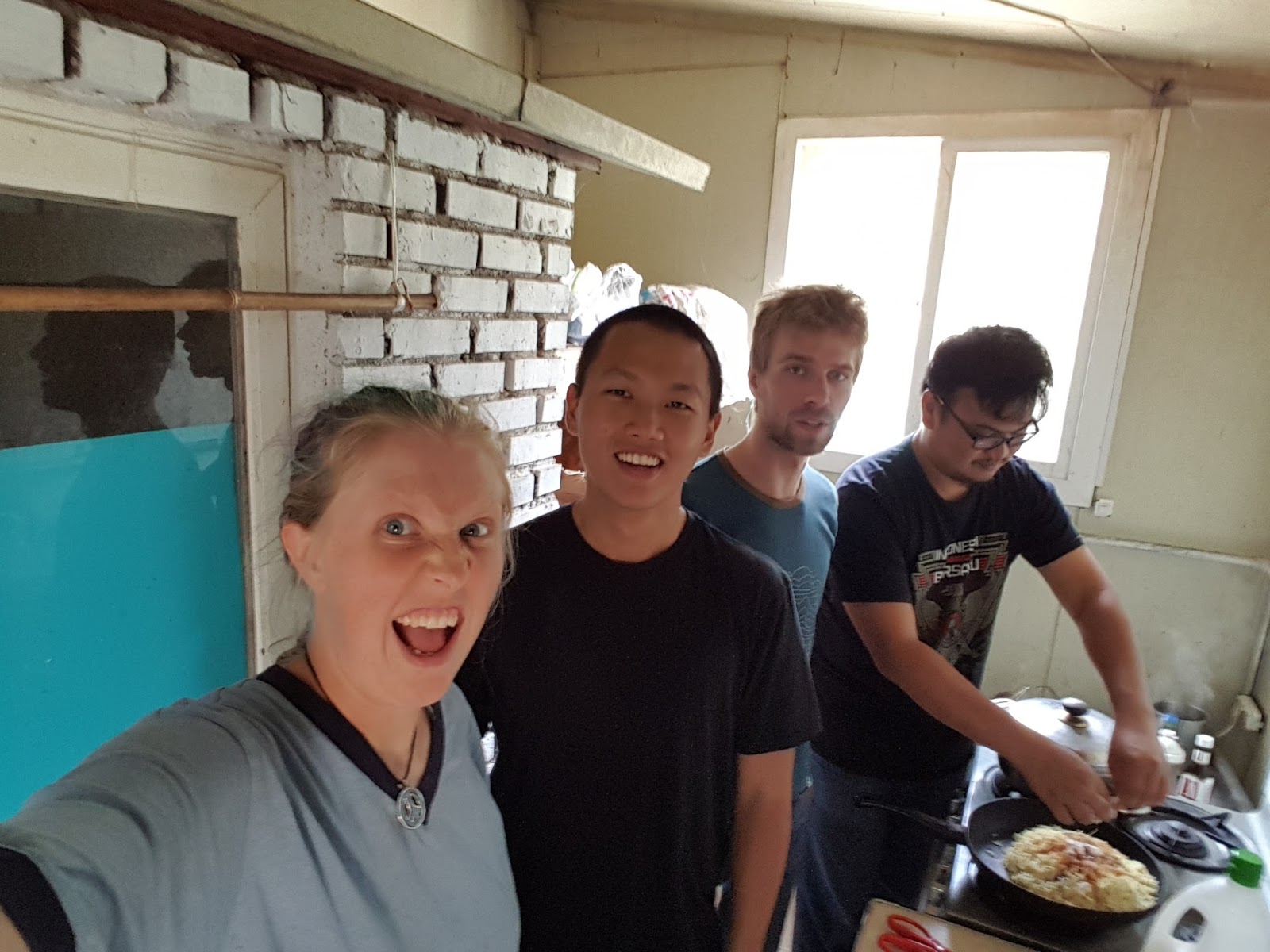
These are the people I live with.  From left to right: Mina, Yehyouk, me, Dante.  Dante and Mina are both excellent cooks.

Also excellent goofballs.

Trip to the Goseon Dinosaur Museum with Dante and Mina


The Chuseok holiday lasted for more than a week at the beginning of October.  During this time, almost everyone was gone from the community.  So, we decided to spend one day exploring a dinosaur museum which was about two hours away by bus.

There were dinosaur footprints in the rock by the seaside, and models of various dinosaurs and their skeletons.  However, we were somewhat preoccupied filming the following Chicken Man episode.


 Night Out in Jinju

Some people with whom I have rubbed shoulders often enough have discovered my weakness of being absent-minded to the extent that I sometimes have no idea where I am or where I am going and must be rescued and lead back to the place where I belong.


One day, however, a teacher at the YWCA in Jinju invited me to a party celebrating the anniversary of her church.  To show everyone how brilliant I could be at going places, I decided to go.  I successfully navigated myself to the church, enjoyed a very nice evening with people I had not met before, and made it back on the last bus out of Jinju.

Methods of transportation included walking, inter-city bus, running, city bus, taxi, walking with a lady and a man, Dandelion School's Vice Principal's car, and, last but not least, a local parsimon farmer's work truck.

Later I found out that by accepting a ride from the parsimon farmer, I put myself in danger of being sold to pirates and spending the rest of days hunched over an oar in the hull of some ship (sorry Grandma).

MCC Retreat in Chuncheon


From October 19 to 22, Dante and I returned to Chuncheon with Mina for the first time since we arrived in Korea.  We got to spend time with Solga our coordinator, who is second to the left, our fellow SALTer, Allison, second to the right, as well as Jenny, Jiwon, and our reps, Donna and Chris and other friends.

We were all happy to spend time together again.  From left to right: me, Solga, Mina, Allison and Dante.


We went for a hike together.  Here I am happy in a tree on top of a mountain.

Here Allison, Solga and Minjeong are also being happy in the tree.  Apparently, this is how monkey impressions are done in Korea.

At the end of our trip, someone off to the side of the road yelled "Canada!" at us as we walked past.  I was the only one from Canada in the group, and my dress was the only possible way he could have known that.

 Hiking Jiri-San

I am still walking like an overweight duck from the Dandelion community's hike up Jiri-San.  Autumn was on the trees.
On the way to the summit.

Geonweon and I raced to the top.  Technically, he beat me.

Jihong in front, Yehyeon in the back right with the phone, and Geonweon taking the photo.  Technically, Yehyeon's pack was heavier than mine.
After reaching the summit, we took this trail to a shelter to spend the night.

Serin and I did this part together. "Teacher, I am sleepy and hungry and tired."

After spending the night in the shelter, we headed back down the mountain.  As a Canadian tree planter, I felt it necessary to really show off how good I am at hiking.  So after I reached the bottom, I went back up to meet people and carry their bags.  Unfortunately, my brilliance at traversing the hiking trail on this occasion was offset by my going half-way up the mountain again on the wrong trail.  Still, Jiri-san was beautiful.


Monday, 2 October 2017

Growing Joy: Humour at the Dandelion Community (Also Chicken Man Begins!)

Humour, Vanity and Joy

I remember thinking once, when I was a youth, that I didn't want to be funny because that would only show that I liked it when others liked me.  I had just started reading C.S. Lewis, and remembered that C.S. Lewis condemned vanity as a vice.  And so, I resolved, there was no good reason for me to be funny.

I think probably, though, I was deceiving myself.  For why else did I not account for the fact that joy is a fruit of the Spirit, and that perhaps good humour might serve the cause of joy?  C.S. Lewis had also said that vanity not as bad as the harder, more self-centred type of pride which makes one not care what others think and feel at all.  I should have realized that humour could be used in the service of joy as a way to care about others.

I also did not see the connection between humour and honesty which I do now.  I have discovered that I am an odd enough person to sometimes make people laugh by doing nothing else than expressing myself honestly.  Maybe humour of this sort presupposes a sort of perspective on yourself that is at odds with vanity.  It is precisely not caring to hide the odd, funny bits about yourself in which this type of humour lies.

Humour at the Dandelion Community

In any case, the reason I am writing this post is because my time at the Dandelion Community, and South Korea in general, has been full of this kind of good, honest humour.  I hope Dante and Mina will not mind me saying that they are odd enough to be funny without trying.  And it has filled our community with one another with joy.

I admit that when I first heard, by email, that the YAMENer I would be staying with was a "comedian," I had my doubts.  Maybe it was the harder type of pride that led me to assume that Dante would be the kind of guy who had come to call himself a comedian because he thought he was funnier than he really was.

But, by God's mercy, Dante is not such a person.  He is a real comedian, and he is really funny.

As evidence, I would like to share this video with you, which Dante made a few days ago.


A Story or Two

Unfortunately, many of the jokes Dante, Mina and I share are such that I cannot write them down for you here without risking expulsion from the Mennonite Central Committee.

However, I think I would be willing to undergo the risk of sharing a story or two.

Many of you will know how important respecting your elders is in Korean culture.  And you must believe me that I have endeavored to do my best in this regard.  I am quick to give up my seat when an older person gets on the city bus.  I bow and say "Anyeonghaseyo?" to our elderly neighbors as they look doubtfully at me from their roadside fields.  When I'm called upon, I help out the little old ladies who all pile onto the morning bus, dragging their farm pickings along with them to sell in the town.

However, I must confess that the cultural adjustment has not always gone so smoothly.

Only last week, for example, I found myself giving my Korean teacher a piggyback around the YWCA concert hall, to the, may I say, excessive merriment of all the Southeast Asian women who also study Korean with us.  In fairness, though, in this case, it was not my fault.  I did not choose of my own accord to parade my Seonsengnim around in front of the whole school.  I would not have chosen of my own free will to introduce Canadian culture to Korea in the style of the half-time show at the Calgary Stampede.  No, the Koreans at the YWCA conceived of this display all on their own.  And, may I say, it was a punishment the likes of which gave me flashbacks to fourth grade, when I was made to sing the Canadian national anthem in front of the class sitting on Mrs. Hutchingson's lap.

Then there was that time, about two weeks ago, when a student's parent gave me an apple.  I sat down and took a break from splitting wood, and then tossed the apple core over the embankment.  Three minutes later, the generous parent returned with my apple core.  He was acting out the scene, quite dramatically I must say, of how the apple core had fallen from the sky and hit him on the head.

I wish I could say that was the last of it, but no.  There is something I did not confess to you about my adventures during my first week in Korea.  If you remember, I related how I had spent a beautiful, romantic night watching Korean musical performances at the historic site where Korean alphabet was invented.  The romance of the night was only increased as sporadic downpours made us open and close our umbrellas as we watched.

I did not relate, however, how the mystique of that night was somewhat punctured by a certain incident.  I confess that I neglected to mention how, after one such downpour, I had raised my umbrella up ever so carefully, so as to avoid hitting anyone as I collapsed it; how, by so carefully raising up my umbrella, in order to not disturb the romance of the night with even the slightest indiscretion, I proceeded, with a release of the umbrella's extraordinarily high-powered springs, to ever so carefully dump all its watery contents directly upon the elderly gentlemen sitting in front of me.

Yes, I confess to you now that MCC chose such a one as most fit to enter Korean culture and represent them.

I know I take a great risk in relating these stories to you.  But I think honesty and good humour demand it.  Yes, these stories are full of good humour, and I confess that the lion's share of it belongs to the Koreans I met over the past month and a half, for which I am certainly thankful!

Sunday, 10 September 2017

The First Two Weeks at Dandelion: A Report and Reflection on My Work

I have now been at Dandelion for two weeks.  So, it is about time I report what I have been up to.  As I confessed in my first post, however, I am a philosopher.  So, I couldn't help adding a little reflection as well.

For those who dislike reflection, I cannot guarantee that you will like any of this post.  However, I have added numbered sections so that you do not have to read too much of it.  Simply read sections I and II.  You could skip ahead and read IV, although I wouldn't recommend it.  Do not, under any circumstances, read section III.  This is even more important to remember if you also dislike poetry.

I.

While I was staying with Donna and Chris Rice, the MCC reps in Chuncheon, I picked up the habit of having devotions every morning.  I don't know whether or not the challenges I faced with all the newness that was a part of my first week in Korea helped me to thoughtlessly absorb this habit from Donna, who practiced it every morning.  In any case, although I have never done before, I now find myself starting my fourth week here with this habit.

It is a new thing for me to give myself time everyday to renew my mind, and then to be able to actively test my reflection through the day, as Paul writes about to the Romans, in order to discern and pursue what is "good and acceptable and perfect."  I think it is a great virtue of this Christian community that the way they live gives me the opportunity both to hard work and to have times of prayerful reflection of this kind.

II.

In my last post, I mentioned working in the chicken barns.  Every morning, Dante and I have helped with feeding the chickens, as well as collecting and getting the eggs ready to be shipped to Dandelion's customers.  I find this regular routine very enjoyable.

One of the first mornings that we did this, I noticed something about it that was unfamiliar to me.  The people in charge of the farm did not shut off certain -- what might be called -- ordinary, emotional responses to their work, that I was used to shutting off.  Let me explain.

One of our first days here, Dante and I found five or so dead chickens outside the barn.  They had been killed by an unidentified wild animal.  Perhaps a cat.  I thought it was unfortunate, but didn't dwell on it.  I found it unusual how Jinha, who is in charge of the chicken barns, looked shocked and saddened when we showed him the chickens that had been killed.  I wouldn't expect this response working for a chicken farm back home.

I had a similar experience when I was cutting weeds, which is another one of my tasks here.  I absentmindedly had cut some purple wild flowers while working on eliminating the weeds and grass beside the road.  I had assumed that they were just another weed, but when Dr. Kim, the headmaster here, saw what I was doing, he told me not to cut those ones.  The reason, I think, was that he liked the way they looked.

III.

In both cases, I would not simply say that a cultural difference was at play.  Yes, this is true enough.  However, even though I think in the culture where I grew up we would not respond the same way in these situations, I would still say that, in both cases, good, ordinary emotions, even as my own culture understands them, were displayed.

The traditions that are a part of my culture express the goodness of compassion for nonhuman creatures and sadness at the loss of beauty.  In my high school lit class, I read Robert Burns express compassion for a "wee, sleeket, cowran" mouse, whose house he had accidentally turned over as he plowed.  He calls to the fleeing mouse:

Thou need na start awa sae hasty,              You do not need to run away so hastily
          Wi’ bickerin brattle!                         little scurrying noise
I wad be laith to rin an’ chase thee            I would not chase you
          Wi’ murd’ring pattle!                       plow

And, lamenting his destruction of a beautiful flower, Burns writes:

Wee, modest, crimson-tippèd flow'r,
Thou's met me in an evil hour;
For I maun crush amang the stoure       I crushed among the flying dust
            Thy slender stem:
To spare thee now is past my pow'r,
            Thou bonie gem.

These are, I think, good, ordinary emotions to feel for animal and plant life that we work with.  And these poems show how they are not simply part of Dandelion culture, but a treasured part of the best of Western culture as well.

While tree planting, my colleagues and I would sometimes quietly express how we wished the forest were better taken care of (by whom?), or lament the fact that we could not spend more time simply appreciating the beauty around us (who could allow us to do that?).  When it came down to it, of course, we would forget such thoughts and all plant as fast as we could with no particular higher goal in mind.

I know some people will simply scoff at the idea of feeling love and appreciation for nature as a part of work life.  But that is neither here nor there.  The question is whether there is a good reason for overturning these ordinary human emotions in our work life.

I am part of a culture that has tended to put our work lives into a box which can be put in a corner away from emotions, like compassion or sadness at the loss of beauty, which fill other parts of our lives.  But what justifies this way of thinking?

I will state my view.  I think that we keep our work life in this box because it is convenient.  We do not have a good reason.  We simply do not want to worry about things like these at work.   After all, we have other things to think about; it is already hard enough to make a living.

When it comes right down to it, however, this is a form of moral heedlessness.  Back home, I did not have a good reason to shut off my capacity for compassion and beauty at work.  I simply did it because I wanted to make money and did not want the inconvenience of attending to life I was hurting or beauty I was destroying.

IV.

As I was fundraising, I had the idea that I really needed to make sure I worked hard and got stuff done when I was at the Dandelion Community.  Only in this way could I justify accepting all the money that friends, family and church members had given me. I still think this, and am happy for all the opportunities I have here to sweat and carry heavy things around.  

However, I now know better that this is not enough.

It is not enough only to do things for the community.  I am here to live well as a Christian disciple among other disciples.  So, I am learning not only to work hard, but to share meals; to spend full day after full day with friends, until our quirks, our struggles and our weaknesses cannot help but rise to the surface, and then to continue to be with each other as friends; and, yes, to reflect, to renew my mind, in order to test and find what, in boxes that I thought I had safely closed off to such things, is good, acceptable and perfect.